ECML PKDD 2026 · Demo Track

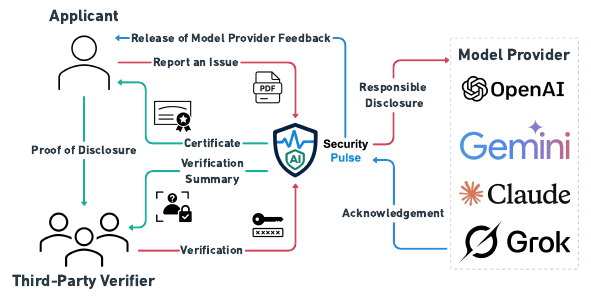
Recent advances in Large Language Models (LLMs) have driven widespread adoption across consumer and enterprise applications, but also exposed critical security vulnerabilities including privacy leaks, jailbreaks, and adversarial misuse. These issues remain underreported due to the fast-paced nature of AI research and the absence of a standardised reporting framework. We introduce AISecurityPulse, a centralised platform that automates and streamlines the responsible disclosure of security issues in AI models. The platform supports anonymous yet cryptographically verifiable submissions, enabling impartial peer review while protecting reporters, and integrates an automated notification pipeline that promptly informs the relevant model providers.
A single, open-source workflow connecting researchers, verifiers, and model providers.
Automated Responsible Disclosure
Structured reports for jailbreaks, prompt injections, and ethical compromises are routed automatically to the right model provider.
Anonymous, Verifiable Submissions
Browser-generated RSA key pairs (2048-bit, SHA-256) let reporters prove authorship without revealing their identity.
Automated Notification Pipeline
A Supabase Edge Function with the Resend API emails providers a standardised, responsive report with a PDF attachment.
Live Model & Provider Registry
A cron job syncs with the OpenRouter API to keep the registry current, covering 139 models across 67 providers.
On submission, the platform resolves the provider's current security contact in real time and dispatches a responsive HTML notification. Each message carries the report metadata, a quoted findings summary, the affected model name, a UTC timestamp, and a PDF attachment. Anonymous reports include an explicit privacy notice to the recipient.
Reporters can also add missing organisations and models directly through the interface; when new provider metadata is supplied, the platform uses it directly, bypassing cached lookups.
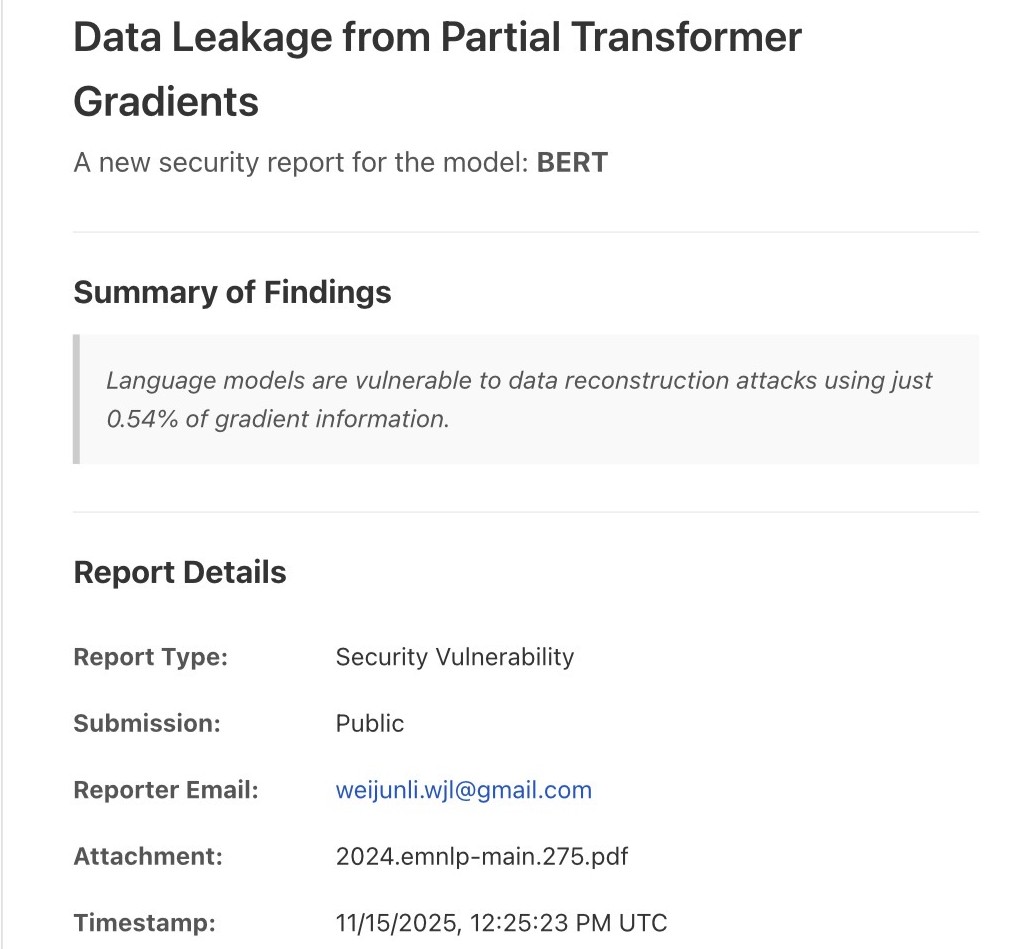
Figure 2. A representative notification as received by a provider.
Cryptographic non-forgeability tests and Grafana k6 load testing confirm both integrity and scalability.
139
Models covered
67
Providers mapped
99.99%
Reliability under load
260 ms
95th-pct latency
Under a sustained load of 51.3 requests/s (≈184k/hour) from 100 concurrent users, the platform held 99.71% performance stability, with only 0.29% of requests exceeding one second. Tamper tests on signed certificates and 1,000 random report IDs all failed verification, confirming that no payload can be altered or forged after the fact.
Each provider is associated with a designated security contact, spanning the major AI labs.
 OpenAI
 Anthropic
 Google
 Meta
 Mistral
 xAI
 DeepSeek
 Cohere
 Nvidia
 Perplexity
 Inflection
 Alibaba
+55 more
@inproceedings{ngo2026aisecuritypulse,
  title     = {AISecurityPulse: Automating Security Issue Reports for AI Models},
  author    = {Ngo, Tuong Phuc and Nakhwa, Sajjad and Li, Weijun and
               Shetty, Anudeex and Xu, Qiongkai},
  booktitle = {Proceedings of the European Conference on Machine Learning and
               Principles and Practice of Knowledge Discovery in Databases
               (ECML PKDD), Demo Track},
  year      = {2026}
}